Pick A Word For 2023 & Stick With It

  1. Share
0 0

It was several years ago when Steve Scherer introduced the concept of picking a word for the new year. This word would be something you could reference throughout the year. I was shocked how much it meant to me that first year and every year since. You can create goals that help make this word be a success throughout the year. It has encouraged me to see progress made monthly in many areas of my life. The word is something that helps me focus on growing and getting better as a person. 


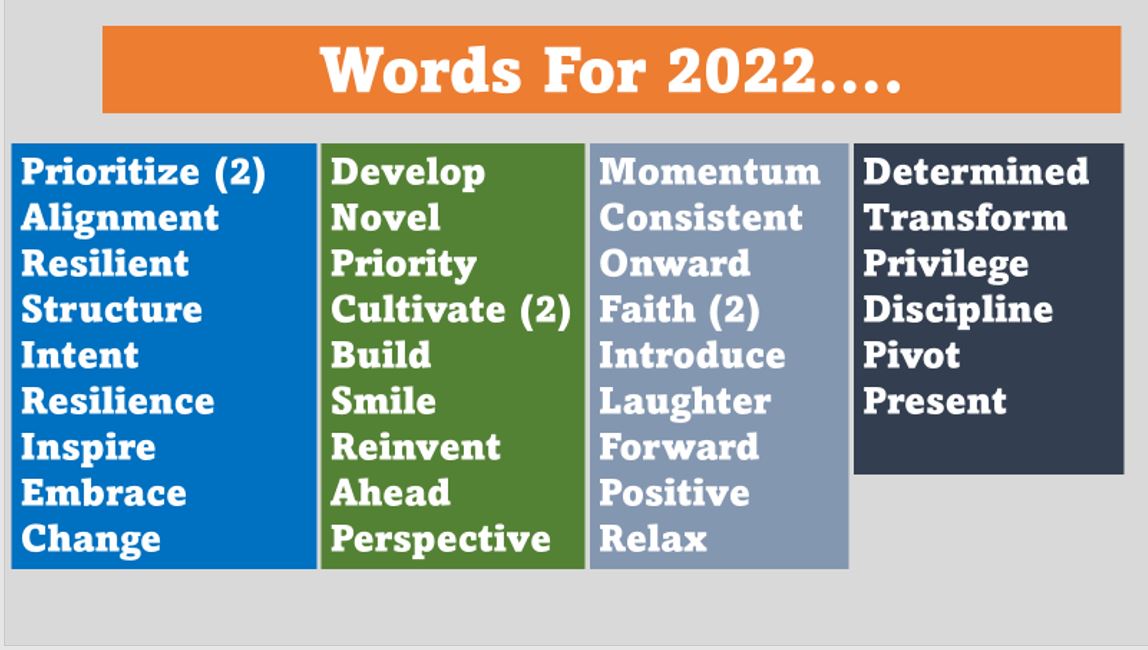
Here are words that our employees picked in 2022....


How do you pick your word?


Reflect on where you want to grow in the new year

  • What made you feel anxious this year?

  • What habits do you want to create?

  • What accomplishments did you achieve this year?
  • What prevents you from living your best life?
  • What makes you feel successful?
  • Who do you want to be known as?
  • How do you take care of your mental health?
  • What are the first three words that come to mind when you think about this new year?


Define your goals and focus areas for 2023

  • Relationships
  • Work
  • Physical Health
  • Wellness and Mental Health
  • Lifestyle and Hobbies
  • Life Milestones


Apply the S.M.A.R.T concept to each goal

  • Specific – Give details on goals and when you know you have completed it.
  • Measurable – Be sure you know short- and long-term benchmarks for success.
  • Achievable – What must you do to find success in this goal and what obstacles will you face?
  • Realistic – What can you achieve towards this goal per month?
  • Time-bound – Put a due date to each goal to create accountability.


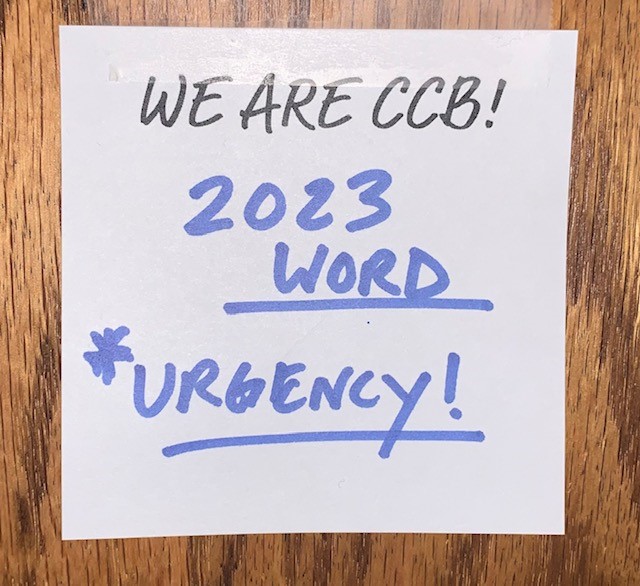
My word for 2023 written on a sticky note above my desk....


The most important part of this word is keeping it FRONT & CENTER so you don’t forget. Stay positive and keep the commitment towards making your word part of your life. Share your word with others and explain why you picked it. The more you talk about it the more it becomes part of your focus. If you really want to kick it up a notch, ask others to hold you accountable on making this word a priority in 2023.


We wish you all a very happy new year and make 2023 be a great year!


*JOIN US FOR A LIVE EVENT ON FEBRUARY 9TH*

Resilient Leadership: Leadership in Uncharted Territory
With guest speaker Tod Bolsinger!

Register HERE
Use discount code: MEMBER23 for 15% off registration


Comments

To leave a comment, login or sign up.

Related Content

0
I Failed as a Dad (and What It Taught Me About Leadership)
I failed as a dad.   At least, that’s how it felt in the moment.   My family and I had just spent nine incredible days in Costa Rica—half in the rainforest, half at the beach. It was one of those trips you hope becomes a core memory. My wife planned the entire thing, and she crushed it. Seriously, she should be a travel agent. My job was simple: show up, drive, and enjoy the ride.   That last part—drive—was harder than expected.   Costa Rican roads are not for the faint of heart. Curves everywhere. Narrow lanes. Horses with riders coming straight at you. At one point, I went through what looked like a cut through alley, which was really a Taco Bell drive‑through. After ninety minutes of white‑knuckle driving, I realized something uncomfortable.   My stress was making everyone else uncomfortable.   Failure #1: Letting Stress Lead In my best “fake college professor” voice, I kept thinking, “THIS IS NOT GOOD. IT IS NOT GOOD.” And it wasn’t.   I let my internal stress leak outward. I wasn’t calm. I wasn’t reassuring. I wasn’t leading. I was surviving—and my family felt it.   We made it through the nine-day adventure, and now it was time to return home. We arrived at the airport two and a half hours early, only to find one airline employee trying to check in at least fifty people. Two lines. One being served. Priority status only.   This is where I made my second mistake.   Failure #2: Being Passive Instead of Leading I stood there. For forty minutes.   I trusted the system even though I could clearly see it was broken. I didn’t step up. I didn’t provide direction. I didn’t cast vision for what we needed to do next.   I was passive.   As leaders—at work or at home—passivity is rarely neutral. It usually costs someone something.   We finally got through TSA, and internally, I was spiraling. Why didn’t you get your family here three hours early? Because the last time I did that (in Chicago), we flew through everything and waited forever.   But this wasn’t Chicago.   This was Costa Rica—and I should have known that.   I stayed quiet, but inside I was convinced we were going to miss our flight because of my poor leadership. I wanted everyone to be happy rather than make a clear, intelligent, strategic decision.   By God’s grace, we made it through with about 20 minutes to spare.   A Brief Moment of Confidence… Then Another Crash My college-aged daughter heard a gate change announcement. I decided I was done being passive.   I asked the gate agent, “Is this flight going to Chicago?” “Yes, sir.”   I asked a man we met in the TSA line, “Is this the Chicago flight?” “Yep.”   I nodded confidently to my family. I’ve got this.   Then I went to get food. Big mistake.   I ordered $80 worth of sandwiches at the only restaurant in the terminal—packed with people—and quickly realized they were serving numbers twenty-five orders ahead of mine.   Then my wife called.   “I think our gate is wrong.”   No way. I had checked. Twice.   I saw the man from the TSA line and asked one simple question that crushed me:   “Are you flying American… or United?”   He replied with “We are on American.”   My stomach sank knowing my family was flying on United.   How could I be so dumb?!   Wrong gate.   Wrong airline.   Total failure (again).   The Lowest Moment—and an Unexpected Gift My wife called again. “Hurry. They’re boarding.”   I abandoned the food, boarded the plane, and felt completely defeated. To make it worse, halfway through the flight, my 10-year-old son started feeling sick—he was so hungry.   I ordered him a snack meal, knowing it was way too little food for $10, but I had no choice.   The flight attendant listened, showed kindness, and gave it to us for free.   Grace.   My son ate. His energy came back. We landed in Chicago. My wife said, “Let’s order deep-dish pizza.”   I ordered two.   The family devoured it.   And finally, I felt like a good leader again.   What I Learned My family never brought up my mistakes. They loved me anyway.   I’m blessed with a family that gives grace. I’m blessed with a God who gives mercy when I mess up.   I share this story because leadership is hard—especially when everyone is watching. And when things go sideways, it’s easy to believe you’re the only one failing.   You’re not. Takeaways Your stress becomes the team’s stress. If you don’t manage what’s happening inside you, it will show up in everyone else. Passivity is still a leadership decision—and usually the wrong one. Seeing a broken system and doing nothing is costly. People don’t need perfection—they need presence and clarity. Confidence, direction, and calm matter more than flawless execution. Grace often shows up after failure. Sometimes through people. Sometimes through unexpected kindness. Always when we’re humble enough to receive it. Action Points Pause before reacting. When stress spikes, slow down. Breathe. Your response sets the tone. Lead with clarity, not approval. Don’t aim to make everyone happy—aim to make wise, timely decisions. Ask better questions sooner. A simple clarifying question can prevent a big mistake. Reflect, don’t retreat. Learn from the miss. Don’t let shame steal the lesson. Extend yourself grace—and keep growing. Leadership is a journey, not a performance. I do Impact of Leadership because I want leaders to know they’re not alone. Stay calm. Lead courageously. Learn from your mistakes. And keep going.   Author: Patrick Booth

0
From Calling to Confidence: How One “Last-Minute Yes” Became a God‑Led Journey of Purpose
a { text-decoration: none; color: #464feb; } tr th, tr td { border: 1px solid #e6e6e6; } tr th { background-color: #f5f5f5; } Two days before a major conference, Tara received a call she didn’t expect. A speaker had thrown out their back, and the organizers needed someone—fast. She was simply on a list of “future possible speakers,” someone who had once said, “If you ever need help, I’d love to speak.” But she had no keynote, no slides, no prep. What she did have was vision, faith, and a God‑given fire burning inside her. She was told, “You’re great at LinkedIn and personal branding—talk about that,” she said: “Okay!” That moment changed everything. This blog is created off the IOL podcast  intreview with Tara LaFon Gooch, #184 Remove Fear By Name It. Tame It. Embrace Your Calling. God Provides Long Before We Feel Prepared Tara’s story is what happens when faith meets opportunity. She stepped onto that stage unsure, unpolished, and unplanned—but fully equipped by God in ways she couldn’t yet see. “The Lord knows the desires of your heart,” she said. “He equipped me before I even realized I needed it.” Sometimes we don’t understand why a passion won’t leave us alone. We don’t understand why we feel pulled toward something that makes no sense. But God does. And He uses those passions as breadcrumbs leading us straight into our purpose. “Once You Name It, You Tame It” — The Fear That Finally Left When I asked Tara if speaking had gotten easier or if she still felt fear, she smiled: “The fear is gone. Once you name it, you tame it.” She explained that fear is natural when you step into the unknown. Your brain fires off warnings: “Is this safe? You’ve never done this before.” But she also said something powerful: Fear shows up the moment you step out of your comfort zone— but that’s also where the magic happens. On that very first stage, talking about personal branding, Tara saw people leaning in… taking notes… nodding their heads… connecting. And she realized: “I’m doing what I’m called to do. I’m making an impact on people’s lives.” Rejection, Redirection, and the Book That Wasn’t Meant to Be Today, Tara has just delivered another keynote. Her third book, From Calling to Confidence, is on the way—a roadmap to help leaders embrace their God‑given assignment. But the journey wasn’t straight. Before this book, she spent 7–8 months writing a 75,000‑word manuscript called GRASP. It was meant for Christian CEOs—until the publisher said: “We’re going to pass.” Most people would have stopped. But Tara didn’t. Instead, she practiced the very first step of her own GRASP method: Gratitude. “It wasn’t a waste,” she told me. “I hold the keys to my future. That ‘no’ redirected me to the book God wanted me to write.” Her lesson is one every leader needs: Never stop believing because of rejection. Look for the redirection. It might be the setup for your greatest impact. The Calling You Can’t Ignore I told Tara, “You’ve been faithful. You surrendered your plans. Now you’re being obedient.” She humbly shared how none of this existed in her family line: No other authors No speakers No entrepreneurs No podcasters She was the first. “I had a God‑given calling,” she said. “No one showed me how. But I couldn’t ignore it.” And today, she’s gathering real case studies from clients whose lives and businesses are transformed by her work—stories that will be included in her newest book. When You Feel the Calling but the World Tells You ‘Don’t’ We talked about the uncomfortable in-between: When you feel called… but your environment doesn’t support it. People tell you not to do it. Doubt creeps in. “What if I fail?” I asked her. “Does that mean I should stop trying?” She pointed to Scripture. She reminded me of David, the forgotten shepherd boy. The least likely. Overlooked. Unprepared by human standards—yet chosen by God. David faced Goliath not because he had approval, but because he had anointing. As Tara put it: “Once you accept God, you are already appointed. You don’t need permission. You just need to step boldly into your calling.” On Hard Days: How to Fight the Lies Everyone sees the wins. But Tara wanted to talk about the hard days—the days when it feels like nothing is working. Her first tool? Recognize the voice. “There is an adversary who wants to trip you up,” she said. “And the easiest tactic is doubt. If he can plant doubt, he doesn’t even need to fight you—you’ll sit out the game on your own.” But here’s the truth she wants every leader to hear: “If the enemy is attacking you, it’s because you’re a threat. That means you have more power than you realize. Show gratitude—and step forward anyway.”