From the Locker Room to Leadership

  1. Share
Impact of LeadershipImpact of Leadership
0 0

From the Locker Room to Leadership

Lessons Learned On and Off the Ice


From an early age, I have been involved in sports, either as a fan or a player. Being the youngest of two, I was introduced to athletic environments through my brother's participation in various sports, which sparked a desire in me to follow in his footsteps. Whatever sport he was playing, I had to give it a try. Once I saw my brother suit up in his goalie gear and take the ice to play hockey, I rushed to my mother and begged her to let me play, not realizing the long-term impact that the sport would have on me.


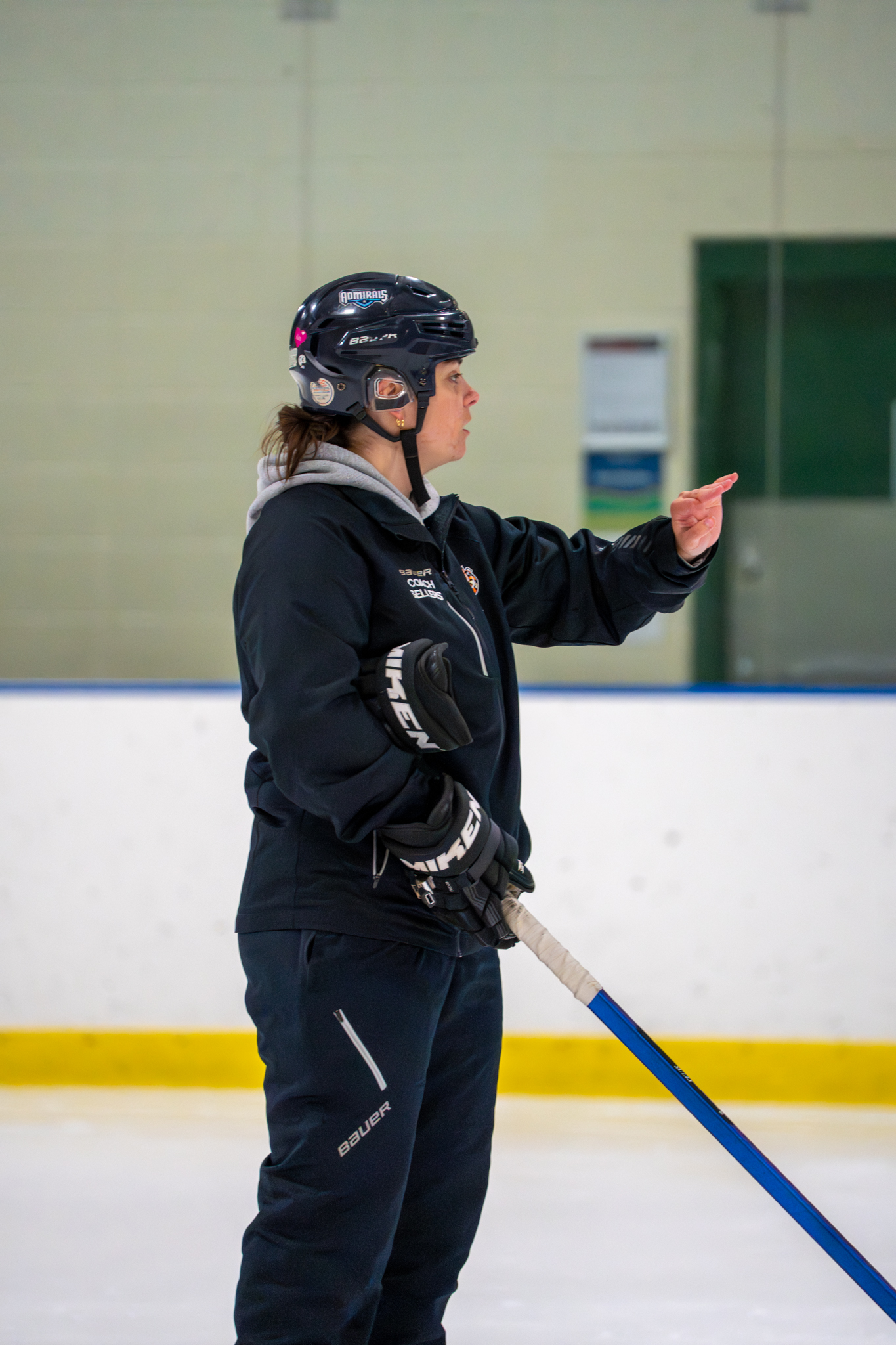
When I began my hockey career, nothing came easy. As a female player on boys' teams, I faced numerous challenges, but those obstacles taught me the importance of hard work and determination from an early age. I had to push myself harder to achieve success while navigating a small locker room that felt more like a closet at the opposite side of the arena, all while dealing with comments about being a girl in a sport often considered for boys. Yet, looking back, I realize that these difficulties shaped me into who I am today. My experience wouldn't have been as valuable if everything had been handed to me on a silver platter.


Being involved in the hockey community has brought fantastic wins and important lessons learned from losses. There have been times when I traveled out of town and spent weekends with the team. When I passed the puck to a teammate who scored a goal, I felt the thrill of stopping the opposing team from winning, leaving me with numerous positive takeaways. However, along with the good times, there have been tough moments from losses. I've experienced being just one goal away from winning crucial games, being on the ice when the other team scores the game-winning goal, and facing complete defeats. These are all part of sports. All these experiences taught me how to lead by example, be a great teammate, lift others up when they're down, and remain calm in stressful situations. I apply these qualities in my current role as a coach, giving back to my hockey community. The player has become the mentor, and I have to thank all the great coaches and leaders who influenced my journey and shaped my leadership style.


As a hockey coach in today's generation, I find there is still much for me to learn each time I step onto the ice or the bench with my teams. I started my coaching career just after graduating from college with the Milwaukee Jr. Admirals. After two seasons with their girls' program, I transitioned to a local youth program called the Vipers Hockey Club. This move also meant leading a younger age group, which was something I had never thought I would do. Now, looking back at that chapter of my life, I see how it pushed me to grow my leadership skills further. Instead of leading high school-aged girls, I now coach players aged eight to fourteen, which presents unique challenges but also allows me to understand how to work with multiple age groups. Coaching various ages has reminded me of many definitions of a good leader. I've witnessed moments where I could see the positive impact I've had, as well as moments that demonstrate I still have room for growth. This is all part of being a leader.


Here are five key leadership lessons that coaching hockey has taught me:


 Patience:

Some players may need time to process information or require reminders. Coaching younger girls has taught me the importance of patience. It can be frustratingwhen they struggle to implement the coach's guidance during practices and games, but that doesn't mean they aren't learning. Instead of getting upset when we don't see immediate results, we must remember that it may take time for them to fully grasp the concepts.


Clear Communication:

Having played hockey for 80% of my life, I've realized that most of my players are just starting out or have only limited experience. Coaches might break down a drill thinking it makes sense, but when we look at our players, they often appear confused. Effective communication is essential for a good leader. The better we communicate and ensure others understand the goals and expectations, the more successful the team will be overall.


Finding the Balance Between Trust and Respect:

In coaching, I have often found myself navigating the delicate balance between earning my players' trust and establishing respect. It can be challenging. We aim to foster strong relationships that can be enjoyable, but we also need to maintain boundaries, ensuring that players view us as trusted advisors who provide guidance. Building strong relationships while demonstrating and earning respect is a vital characteristic of a good leader.


Holding Players and Yourself Accountable:

As a coach in sports, accountability plays a significant role in a team's success. It's important to remember that both you and your players will make mistakes. I've learned to keep this at the forefront with my teams because holding ourselves and each other accountable leads to future success. Without addressing and discussing mistakes, there can be no growth in skills. For instance, one of my younger players recently had a challenging game where her emotions got the best of her, and she was not a good teammate that day. We, as coaches, acknowledged the situation. I then stepped in to help the player understand her accountability for her behavior, while also taking the time to listen to her perspective. She later apologized to both the coaches and the rest of the team. My point is that if we hadn't addressed the issue at that moment, the player would have missed the opportunity to learn from the situation. This principle applies not just in sports but also in work environments and family settings.


Adaptability:

The game of hockey is fast-paced and constantly changing, leaving little time to cling to old ways or feel comfortable. As a leader in the hockey community, I have learned the importance of adapting to whatever situation arises. Coaching girls' hockey can be quite unpredictable; one season, you might have a full roster and experience great success, while the next season, you may struggle to find enough players for a team. Additionally, the program I coach for often has most of its female players double-rostered, meaning they also participate in co-ed games. This requires further adaptation. We may have a full team for one game, but the next, we could only have ten skaters available. This necessity for adaptability extends beyond hockey; it applies to being a leader in any setting. Challenges and changes will come, but instead of freezing in the face of uncertainty, remember that you are a leader for a reason, and you are exactly where you are meant to be.


We hope you take away a few thoughts on how these lessons can apply to you and your leadership style to help you be the best leader you can be.


Want to hear another story about how sports can relate back to leadership? Listen to The Impact of Leadership episode 148 - Pushing The Boulder Up The Mountain with guest Kevin Fillers.


Written By: Haley Sellers -The Impact of Leadership Marketing Brand Coordinator

Community tags

This content has 0 tags that match your profile.

Comments

To leave a comment, login or sign up.

Related Content

0
How To Be A Great Board Member
How To Be A Great Board Member And Make a Huge Difference   Lots of good work is happening around you in your community. I can guarantee there are least four organizations a stone’s throw from your office that are dedicated to helping others.  Houses are being built for those who can’t afford them at market rate. Exercise classes are being taught to lonely elderly who need social connections and ways to stay healthy. After-school programs are giving children a warm and safe place to be while their parents finish their workday. The list is endless.   These organizations are usually being run by mission-driven, big-hearted, thinly spread executive directors who need your help. While giving financially is, of course, always an option, the best thing you can do with your experience, position and resources, is to join the board of directors.   The board of directors is a group of volunteers who help the executive director fulfill the mission of the organization. This is a great way to truly serve in your community, but it’s not always easy. You can choose to simply fill a seat, or you can be a great board member.   According to Grant Buenger, Executive Director of Racine Habitat for Humanity, the board has a huge impact on the success rate of a non-profit organization. Buenger, who has served on multiple boards himself and now leads his own at Habitat, says that all board members are usually well-intentioned but without proper training in governance, the board as a whole can become a traffic jam of egos, poor execution and bad meetings, leaving the board ineffective and an executive director exasperated.   Being a great board member can have the opposite effect by supporting the executive director, growing the organization, fulfilling its mission and changing a community. Buenger offers the following ways to be a GREAT board member:   Learn the ins and outs of the organization: Ask questions. Learn the structure of the organization, its mission, history, goals and programs. Listen to the executive director and truly understand what he or she is doing to fulfill the mission. You are there to help steer the ship, but the ED is the captain. Get on board with his or her vision, making sure that person feels encouraged and supported. Approach the other staff with a position of humility and ask them about their jobs and the daily operations. The more you understand about the organization the better you can help steer it.   Make sure your input aligns with the mission: Fulfilling the mission is the top priority. Use that lens to filter your comments, ideas and decisions. Continually check to make sure that you’re not letting your personal opinions, ego or just plain fear get in the way of you serving the organization in such a way that furthers the mission. You have great resources, experience and expertise to bring to the table but it's only useful if you are tailoring what you offer to the needs of the organization. Think about what’s needed first, then how you can help fill that need.   Bring resources to the table: Here’s where you get to shine. The two things non-profits need the most are money and connections. You can leverage yours for the organization. Advocate for the cause in your social circles. Talk about the mission and organization everywhere you go. Showcase your excitement and support. Invite those you know to participate in fundraisers or other events and tell them that you are giving to the cause, encouraging them to do the same. Use your season tickets to take a potential donor to the game or offer unused tickets to the ED for him or her to do so. Your energy and support is contagious. Use it to make a difference. Roll up your sleeves and work: Non-profits generally have lots of volunteer opportunities. You can join a board committee in your field of expertise, offering to review financial documents, lead projects or support other employees. You can also volunteer in the actual programs, such as mentoring a youth, building a home or organizing an office. Make sure to show up for these tasks as an actual volunteer, taking direction from others instead of offering your expertise.   A great board member is a huge asset to an organization. You can be that asset. ### This blog post is based on the IOL Podcast #147 Building Hope and Transformational Leadership with Grant Buenger.   Blog Author: Ashley Buenger      
0
Whoops! On Making Mistakes
Whoops! On Making Mistakes   I was working as an intern at a Public Relations and Marketing firm during my final year of college. I was tasked with creating an Excel document that showed one of our biggest clients how valuable our services were. It showed them, in dollars, how effectively we had carried out their campaign.   After compiling and calculating all that we had done, I discovered our final ROI number had six figures! My boss was elated. We celebrated with Guinness beers around the conference table, toasting to the fruit of our hard work.   A day later, my boss came back to me with the document and showed me an error I had made. In creating the Excel formula, I had accidentally doubled the final number. The ROI was a much more modest number, not six figures.   I still cringe thinking about that disappointment.   The highlight of the story, however, is that my boss was incredibly gracious and kind. She had every right to be angry. She was the one with egg on her face in front of the client. She  was the one who sat there while they pointed out that the math didn’t quite add up. Instead of passive aggressively taking me off additional projects or relegating me to endless Excel trainings, she calmly showed me the error and we talked about how to avoid it in the future. She continued to trust me and allow me to do work that was valuable to the firm.   This was the greater lesson to me—her excellent leadership. Not only did she handle my mistake with kindness, but she also gave me the space to learn from it. I worked much harder after that, double checking and rechecking the documents I created.   Over the years, I have come to see that these are some of the most important moments in leadership. These are the moments that define a leader, a company and a culture. A good leader chooses to teach and guide an employee in the face of an honest mistake instead of addressing it with frustration, ignoring it, or letting it impact that employee’s position in the company.  A good leader even turns that mistake into a very important opportunity.   Here are 3 quick tips on how to be a good leader in the face of others’ mistakes:   Don’t be surprised: People are human, mistakes are going to happen. There is no avoiding them. This is especially important for those of us who strive for perfection and think it is attainable. We must learn that no amount of planning, preparation or hard work is going to keep mistakes from happening. They are a fact of life and everyone makes them. I’ll say that again for those in the back. EVERYONE makes them.   Instead of treating mistakes like a nuisance, like a boulder in the middle of the road, or a stain on your favorite shirt, treat them like a welcome family member at a dinner party. They are good. They are necessary, and they will make your employees, and your company grow. They teach us important things and lead us places we did not even know we wanted to go. Let’s embrace them instead.   When they happen, handle them with tact. It’s best to address mistakes in private with the employee directly. Do it quickly and with discretion. Communicate what happened, any consequences of the mistake and the handling of them, and how it could be an opportunity for growth and change.   If it’s necessary to communicate with the entire team about the mistake, do so with thoughtfulness. Don’t forget to address the possibilities it has created or the positive outcomes. Be honest and open, but remember you frame the narrative. Think about what you are creating and how you want to lead through this, then choose your words, body language, and message accordingly.   Hold people accountable, coach them toward understanding and growth. Remember that mistakes are a part of growth so they should be welcomed and, in some cases, even embraced. Make sure you are not ignoring or avoiding them. Accountability is necessary. If the same mistake is being made over and over, that needs addressing. There will be no growth or learning if employees are not held accountable for their actions.   Remember that the same mistake might be made twice, coaching and leading requires a lot of patience, especially when working with employees who operate quite differently than you do. Bring in help from outside leaders or other coaches if needed. Notice pain points among your team where there might be a lot of mistakes being made. Large group training and coaching can also be helpful.   It may go without saying, but how you handle your own mistakes will say a lot about how you handle others’ mistakes. When you mess up, if you are quick to dust yourself off and try again, then you are more likely to have that same attitude with your employees. If you are hard on yourself, berate yourself and wallow in the failure, then you may have more trouble giving others space to make mistakes.   Consider these things and may you be the best leader you can be.   ###   This post is based on the IOL Podcast Episode #159: Embracing Economic Growth with Nicole Ryf. Listen for lots of good takeaways including more on leading through mistakes.   This blog was written by Ashley Buenger